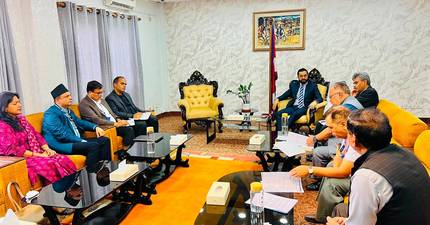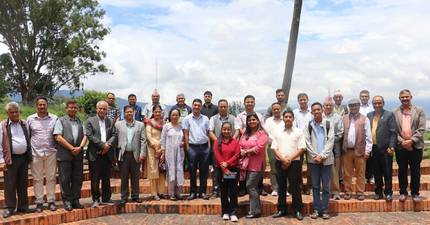






Kathmandu, July 3–4, 2026: In one of the most consequential shake-ups of Nepal's public university leadership in years, Prime Minister Balendra Shah, who also serves as Chancellor of the country's public universities, appointed new Vice-Chancellors (VCs) to seven universities on Friday, Asar 19, 2083. The Education and Sports Minister, Sasmit Pokharel, administered the oath of office and secrecy to the new appointees the same day.
Why this matters: the ordinance that emptied Nepal's university leadership
The appointments close a nearly ten-week leadership vacuum that began on Baisakh 20, 2083 (May 2, 2026), when President Ramchandra Paudel, on the recommendation of the Balendra Shah government issued three ordinances in a single day:
- An ordinance amending several Nepal Acts relating to universities,
- A parallel ordinance amending Acts relating to Health Science Academies, and
- The "Special Arrangement for Removal of Public Office-Holders Ordinance, 2083," which terminated Vice-Chancellors, Registrars, Rectors, board chairs, and other office-holders who had been appointed by earlier governments across essentially every public university, health science academy, and the University Grants Commission (UGC).
In total, roughly 1,594 office-holders across the education sector lost their positions in that single day, including the leadership of Kathmandu University (VC Achyut Wagle, Registrar Rajiv Shrestha, and all seven school deans), Purbanchal University (VC Biju Kumar Thapaliya), Far-Western University (VC Hem Raj Pant), Pokhara University (VC Bedraj KC), Agriculture and Forestry University or AFU (VC Sharada Thapaliya), Mid-West University (VC Dhrub Kumar Gautam), Lumbini Buddhist University (VC Suvarna Lal Bajracharya), Nepal Sanskrit University, Madan Bhandari University, and Yogmaya Ayurveda University, along with the UGC's own chairperson and members.
Tribhuvan University's top officials; VC Dr. Dipak Aryal, Rector Prof. Dr. Khadga KC, and Registrar Prof. Dr. Kedar Prasad Rijal had already resigned collectively a few days earlier, on Baisakh 17 (April 30, 2026), explicitly to "pave the way" for the incoming government rather than wait to be removed by ordinance.
From vacancy to open competition
With universities running for months on caretaker or acting leadership, the government moved to fill eight VC posts; Tribhuvan University (TU), Purbanchal University, Pokhara University, Lumbini Buddhist University, the Agriculture and Forestry University, Mid-West University, Far-Western University, and Rajarshi Janak University, through open, merit-based competition for the first time, rather than the customary practice of political parties dividing posts among themselves.
- Applications invited: Baisakh 25 (May 8, 2026), under a newly approved "Integrated Procedure for Selection and Recommendation of Vice-Chancellors of Various Universities, 2083."
- Total applications received: 218, ranging from 50 for TU and 38 each for Purbanchal and Pokhara, down to 11 for Lumbini Buddhist University.
- A Selection and Recommendation Committee chaired by Education Minister Sasmit Pokharel formed an expert sub-committee to score candidates on academic background, experience, published research, a written vision/strategy paper for the university, and an interview presentation.
- Shortlists of up to 10 names per university were published around Jestha 22, followed by public feedback, interviews, and a final list of three candidates per university (Asar 16 / June 30).
- From each three-candidate shortlist, Chancellor and PM Balendra Shah made the final appointment on Asar 19 (July 3, 2026).
Lumbini Buddhist University's Vice-Chancellor appointment remains pending, according to the Ministry.
Caretaker leadership during the transition
With substantive VCs removed and open competition taking roughly ten weeks to complete, the Chancellor's office assigned caretaker (acting) Vice-Chancellors at each affected university on Baisakh 30, 2083 (mid-May 2026) to keep academic and administrative operations running. These were:
- Tribhuvan University: Prof. Dr. Sushil Bahadur Bajracharya, Dean of the Institute of Engineering.
- Purbanchal University: Prof. Dr. Biju Kumar Thapaliya reappointed on a caretaker basis, having previously served a full substantive term as Purbanchal's VC.
- Pokhara University: Prof. Dr. Bishnu Raj Tiwari, School of Health and Allied Sciences.
- Far-Western University: former Registrar Prof. Yagya Raj Pathak.
- Mid-West University: Prof. Dr. Narayan Prasad Paudel, former Registrar of the university.
- Rajarshi Janak University: Prof. Dr. Vidya Sagar Verma.
- Lumbini Buddhist University: Assoc. Prof. Dr. Manik Ratna Shakya, Dean of the Faculty of Buddhist Studies.
- Kathmandu University: Prof. Dr. Rishikesh Wagle
Who was appointed where
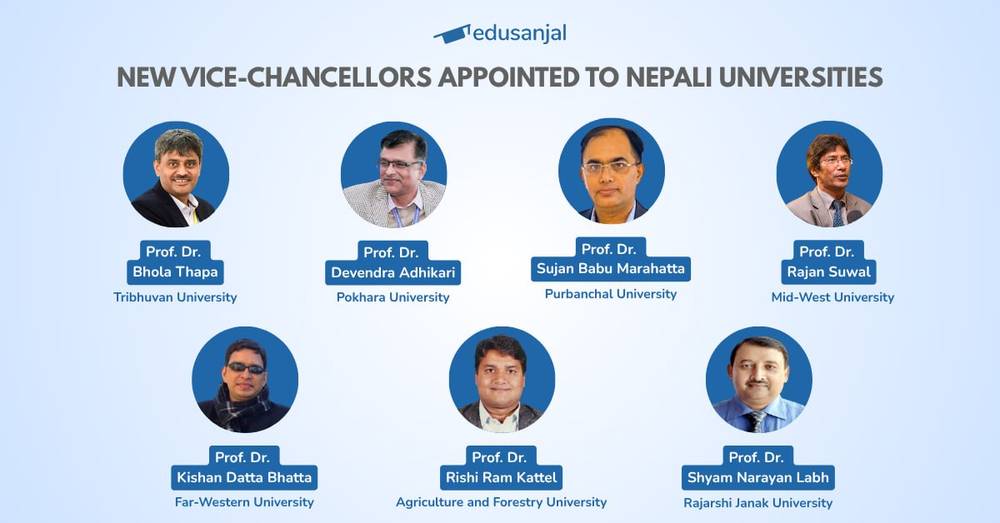
| Tribhuvan University (TU) | Prof. Dr. Bhola Thapa, former Vice-Chancellor, Kathmandu University |
| Purbanchal University | Prof. Sujan Babu Marahatta, professor, Nepal Open University; former Director, Medical Education Commission (MEC) |
| Far-Western University | Prof. Kishan Datta Bhatta, professor of Engineering; PhD in Urban Planning & Design, University of Hong Kong |
| Mid-West University | Prof. Rajan Suwal, TU associate professor, Civil Engineering Department, Pulchowk Campus (IOE) |
| Pokhara University | Prof. Devendra Adhikari, TU professor, Mahendra Morang Campus; PhD in Physics, Tilka Manjhi Bhagalpur University |
| Rajarshi Janak University | Prof. Shyam Narayan Labh, TU professor of Zoology; PhD, University of Delhi (fish nutrition) |
| Agriculture and Forestry University (AFU) | Prof. Rishi Ram Kattel, AFU professor; PhD in Agricultural Economics & Management, AFU |
What the government is asking of the new leadership
At the oath-taking, Minister Pokharel outlined explicit expectations for the incoming Vice-Chancellors:
- Work independently, transparently, and professionally, "without succumbing to anyone's pressure."
- Make the mandatory 10% scholarship provision transparent and functional across universities and their affiliated campuses wherever feasible.
- Remove trade-union and student-union banners and structures from university and campus premises.
The new VCs, for their part, publicly committed to working "fearlessly and honestly" to protect institutional credibility.
What this means for students and families
For prospective students, the immediate significance is stability: after months of vacant or caretaker leadership at most public universities which had already begun delaying policy decisions, faculty promotions, and college affiliations; each university now has a confirmed Vice-Chancellor able to take institutional decisions.
The government's stated intent to reduce party-political interference in university leadership, if sustained, could also translate into more predictable academic calendars and administrative processes over the coming academic year.
Edusanjal will track how each university's new leadership addresses affiliation processes, examination schedules, and scholarship implementation, since these directly affect admission planning.