

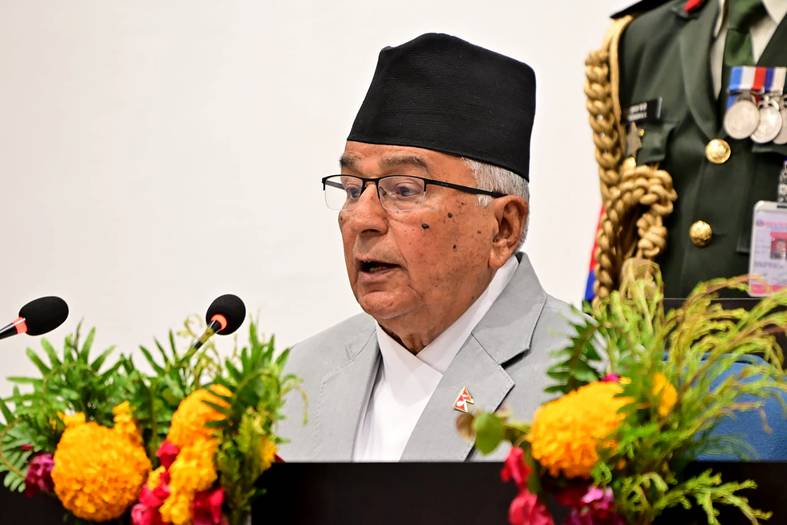



Kathmandu: In a bid to establish education as the foundation for equity and prosperity, President Ram Chandra Paudel has announced a comprehensive set of reforms and initiatives for the upcoming fiscal year. Addressing the joint session of Parliament, the President emphasized that the state will guarantee free education up to the secondary level.
1. Strengthening Public Education and Regulation
The government has pledged to ensure the smooth distribution of textbooks, midday meals, and school uniforms. To enhance the quality of education, curricula across all levels will be reviewed to make them more contemporary, life-oriented, and employment-centric.
While increasing long-term investment in public education, the government also intends to implement healthy regulations for private educational institutions. These institutions will be encouraged to become more service-oriented and quality-focused.
2. Digital Transformation and AI Integration
A major highlight of this year's policy is the expansion of E-learning, virtual classrooms, and open digital content. The government plans to:
- Expand learning systems based on Artificial Intelligence (AI).
- Equip 10,000 community schools with high-speed internet, digital materials, and AI-based learning systems.
- Formulate an integrated plan for school mapping, merging, and improving infrastructure like libraries and laboratories.
3. Higher Education and Labor Market
To address unemployment, higher education will be closely linked with the labor market. The government has announced plans for the academic and administrative restructuring of universities to make them more efficient and globally competitive.
4. National Employment, Skills and Remote Work Policy
A new national employment policy will be formulated to integrate skills, education, labour market information, social security, and employment service systems. A national apprenticeship program based on the “earn while you learn” concept will be implemented.
A legal framework for a “remote work policy” will be introduced, allowing Nepali citizens to work for foreign employers while staying in Nepal. The skills of youths returning from foreign employment will be documented through a digital “Skill Passport” and provided with international professional certification.
5. Inclusion and Social Justice
The policy aims to ensure equal access to quality education for children from impoverished, marginalized, Dalit, and indigenous backgrounds, as well as those from backward regions and those living with disabilities.
- Special Needs: Specific focus will be given to children with Autism and Neurodiversity through therapy services, assistive technology, and the development of inclusive school systems with specially trained teachers.
- Digital Stipends: To ensure transparency, all scholarship programs will be merit-based and payments will be made directly to students' bank accounts via digital systems.
6. Teacher Reforms and Management
The government has committed to making teacher recruitment, promotion, and evaluation entirely merit-based and transparent. Key highlights include:
- Ensuring professional development and proper record management for teachers.
- Guaranteeing fair compensation and introducing incentive programs for "Excellent Teachers."
- Reviewing the evaluation and certification systems to make school education more learning-oriented rather than exam-centric.
7. Youth, Sports, and Volunteer Programs
Talent identification programs will be launched from the school level. Sports will be linked with national unity, health, tourism, and the economy, along with the commercialization of the sports sector and social security for athletes.
A national volunteer program will be introduced to engage youth in digital literacy, community service, innovation, and local development.