

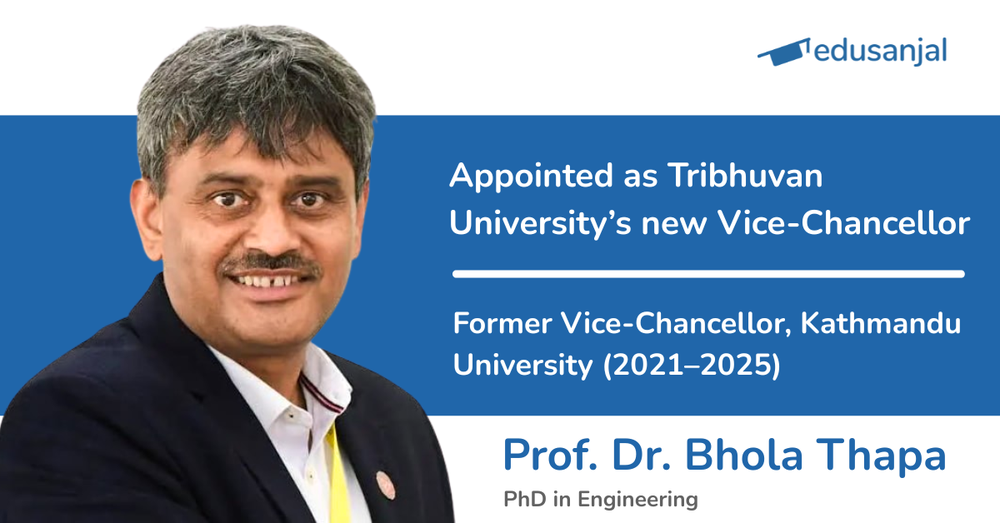



Prime Minister and Chancellor Balendra Shah appointed Prof. Dr. Bhola Thapa as Tribhuvan University's new Vice-Chancellor on Asar 19, 2083 (July 3, 2026), selecting him from a shortlist of three finalists put forward through the government's open competitive process. He took the oath of office and secrecy the same day, administered by Education and Sports Minister Sasmit Pokharel, becoming the leader of Nepal's oldest and largest university at a moment when it has gone without confirmed leadership for roughly two months.
| New Vice-Chancellor | Prof. Dr. Bhola Thapa |
| Appointed | Asar 19, 2083 (July 3, 2026), by PM & Chancellor Balendra Shah |
| Prior Leadership Role | VC Kathmandu University |
| Selection process | Open competition; 50 applicants for TU's VC post |
| Outgoing VC | Prof. Dr. Dipak Aryal (resigned April 30, 2026) |
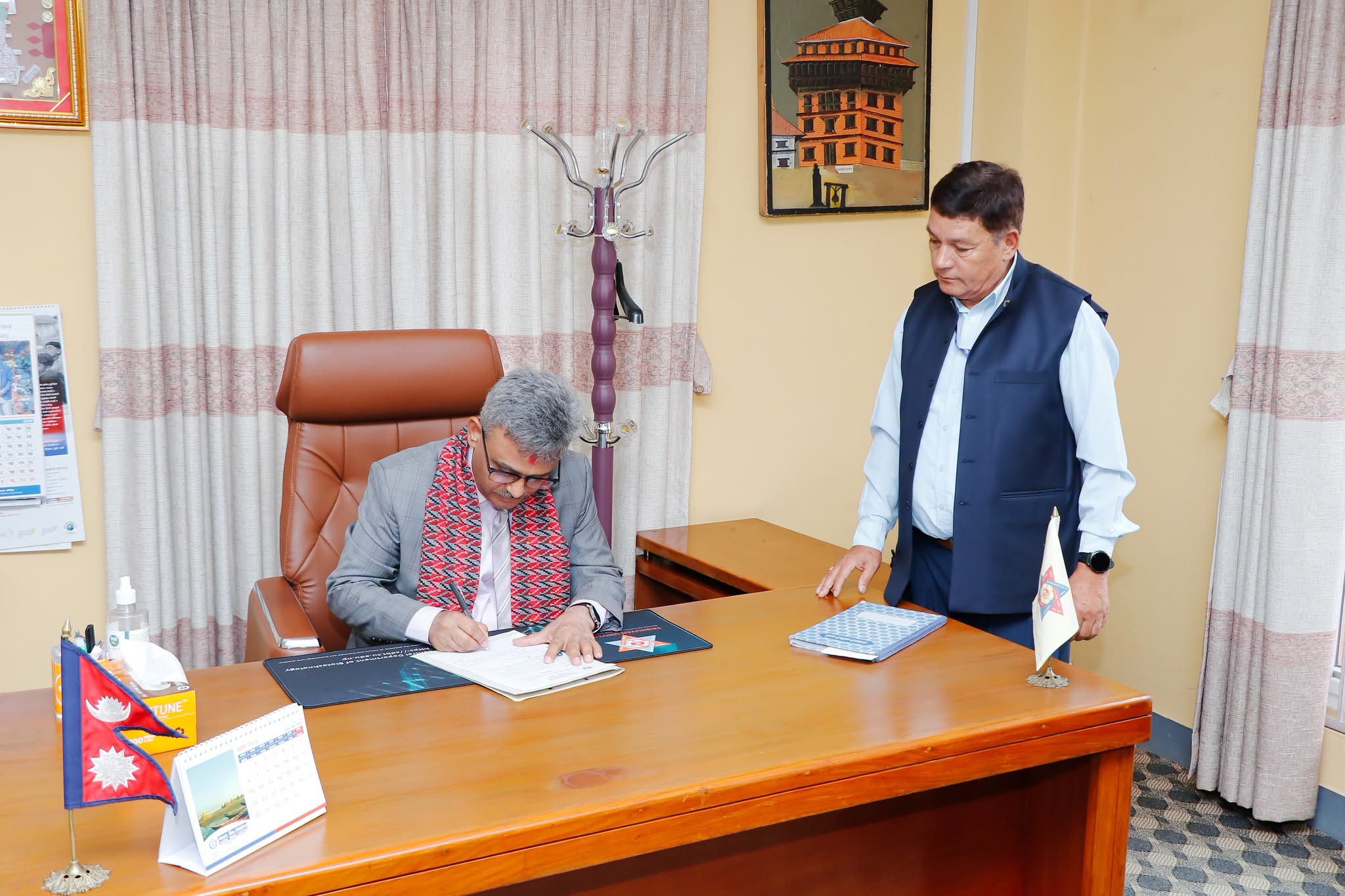
On Asar 22, 2083, Prof. Dr. Bhola Thapa formally assumed office as the Vice-Chancellor of Tribhuvan University. Addressing the handover ceremony, he reaffirmed his commitment to working collaboratively with all stakeholders to strengthen Tribhuvan University and further enhance its standing as one of Nepal's most prestigious higher education institutions.
He said he would dedicate himself to making the university an even more outstanding institution by incorporating the views, suggestions, and support of faculty members, staff, students, and other stakeholders.
The ceremony was attended by former Acting Vice-Chancellor Prof. Dr. Sushil Bahadur Bajracharya, Acting Rector Prof. Dr. Shankar Prasad Khanal, Acting Registrar Prof. Dr. Mahananda Chalise, deans of various institutes and faculties, executive directors of research centres, directors, division heads, faculty members, staff, and students.
Background: Who is Dr. Bhola Thapa?
Dr. Bhola Thapa built his academic career almost entirely at Kathmandu University (KU). After starting out in government engineering service, he joined KU as an assistant professor through open competition, and went on to complete his own Master's and PhD there. His doctoral research focused on sand-erosion behaviour in hydraulic-machinery turbine runners. He rose through the ranks at KU as professor, assistant dean, and executive dean, before serving as Registrar.
In Magh 2077 (January 2021) he was appointed Vice-Chancellor of Kathmandu University, a position he held for roughly four years before Prof. Achyut Wagle succeeded him. Wagle's own KU leadership team was later removed in the May 2026 ordinance
How he led at Kathmandu University
During his KU tenure, Dr. Thapa is credited with several initiatives:
- Integrating indigenous and traditional knowledge systems alongside modern science in the curriculum.
- Launching teacher-training programmes for university-level educators.
- Introducing Yoga as an undergraduate subject and creating a "Bachelor in Craft and Design" programme.
- Starting a "Bachelor in Heritage" programme aimed at preserving Nepal's traditional craft and heritage skills.
- Expanding international partnerships, including a Yogic Science programme with an institution in Tirupati, India, and joint initiatives with IIT Madras.
- Securing UGC quality-assurance and accreditation (QAA) status for KU's Engineering Faculty.
- Developing a turbine-testing laboratory at KU, drawing on his own hydropower research background.
He has authored three books, more than 100 papers in international journals and conferences, and roughly 30 articles, and has held additional roles including membership of the Medical Education Commission (MEC), the Far-Western University Senate, and the Nepal Academy of Science and Technology (NAST).
Why the TU post is a different scale of challenge
In an interview given around the time of his appointment, Dr. Thapa was direct about the difference in scale between KU and TU: Tribhuvan University accounts for more than 75% of Nepal's total higher-education enrolment (over 500,000 students) compared with KU's much smaller student body. He framed his goal not merely as "fixing TU" but as lifting the standard of Nepali higher education more broadly.
Asked about TU's long history of strikes, lockouts, and prolonged closures, he described the moment as an opportunity rather than an insurmountable problem, pointing to the government's stated intent to reduce politics in university administration. He noted he is not entirely an outsider to TU either, he completed his own I.Sc. at Amrit Science Campus and has long collaborated with TU's leadership in various capacities.
On the recurring question of political favouritism, Dr. Thapa has pushed back directly, stating that his appointment came through open, merit-based competition; a process open to Nepali academics globally and evaluated by an independent system rather than political affiliation. He has pointed out that he was appointed to KU under one government and has now been appointed to TU under a different one, arguing this undercuts claims of partisan selection.
Stated priorities at TU
- Recovering funds and enforcing accountability from faculty and staff who took study leave abroad on university funding but did not honour agreements to return and serve.
- Protecting and reclaiming university-owned land that has been encroached upon or diverted to other uses over the years.
- Addressing the long-running Laboratory School controversy; a government-established school historically linked to TU, now seen by some as occupying TU land. Rather than demolition or relocation, Dr. Thapa has indicated a preference for restoring and strengthening the school's original institutional link to TU, after first studying how it is currently managed.
The predecessor: how TU's last leadership team departed
Dr. Thapa inherits a university whose top leadership left under significant political pressure rather than completing a natural four-year term:
- Prof. Dr. Kesharjung Baral was appointed TU Vice-Chancellor by the Pushpa Kamal Dahal government on a competitive basis, but resigned under pressure once the KP Sharma Oli government took office.
- Prof. Dr. Dipak Aryal was then appointed VC by the Oli government on Asar 25, 2082 (July 2025).
- Rector Prof. Dr. Khadga KC and Registrar Prof. Dr. Kedar Prasad Rijal had been appointed earlier, on Chaitra 30, 2080 (April 2024), by the Prachanda government, on the recommendation of then-VC Baral.
- All three (Aryal, KC, and Rijal) resigned together on Baisakh 30, 2083, submitting individual resignation letters to Chancellor and PM Balendra Shah. They said the move was meant to "pave the way" for the new government, at a time when the government was already preparing an ordinance that would have removed politically appointed office-holders by law in any case.
- The Chancellor's office then assigned Prof. Dr. Sushil Bahadur Bajracharya, Dean of the Institute of Engineering, as Acting Vice-Chancellor on Baisakh 30, 2083, to keep TU running until a permanent VC was selected through open competition.
TU's legally mandated four-year term for such office-holders was effectively bypassed by the ordinance mechanism, and the university ran on interim/caretaker arrangements for roughly two months before Dr. Thapa's appointment.