




Bridging Technology and Finance:
Inside the NC-ITSIFM-2026 National Conference
On July 4, 2026, the Research Management Cell of Academia International College, Lalitpur, hosted the National Conference on Integrating Information Technology for Sustainable and Innovative Financial Management (NC-ITSIFM-2026) at the Academia Seminar Hall. The day-long event brought together academics, researchers, scholars, and industry voices to explore how digital technology, artificial intelligence, and data-driven tools are reshaping the future of financial management, with sustainability and innovation as the guiding threads.
The conference unfolded across four parts: an inaugural ceremony, a keynote session, three parallel technical paper-presentation sessions, and a valedictory/closing session.
Inauguration: Setting the Tone
The morning began with registration and breakfast from 8:00–8:30 AM, followed by the formal Inauguration of the National Conference from 8:30–9:00 AM, emceed by Academic Head Bishwa Mathema.
The dais was shared by Chairperson Bobby Pradhan, Campus Chief Rajesh Prasad Shrestha, Board Member Dharma Maharajan, and other dignitaries, alongside the two Chief Guests, Prof. Dr. Gyan Pradhan of Christopher Newport University, USA, and Kul Bahadur Maharjan, Chairman of Lalitpur Metropolitan City–7, and Special Guest Dr. Rajan Bilas Bajracharya, Head of the Research Management Cell.
The inauguration followed traditional academic protocol, a Khada welcome program, lamp-lighting by the Chief Guests, Chairperson, Campus Chief, and Head of RMC, followed by the national anthem.
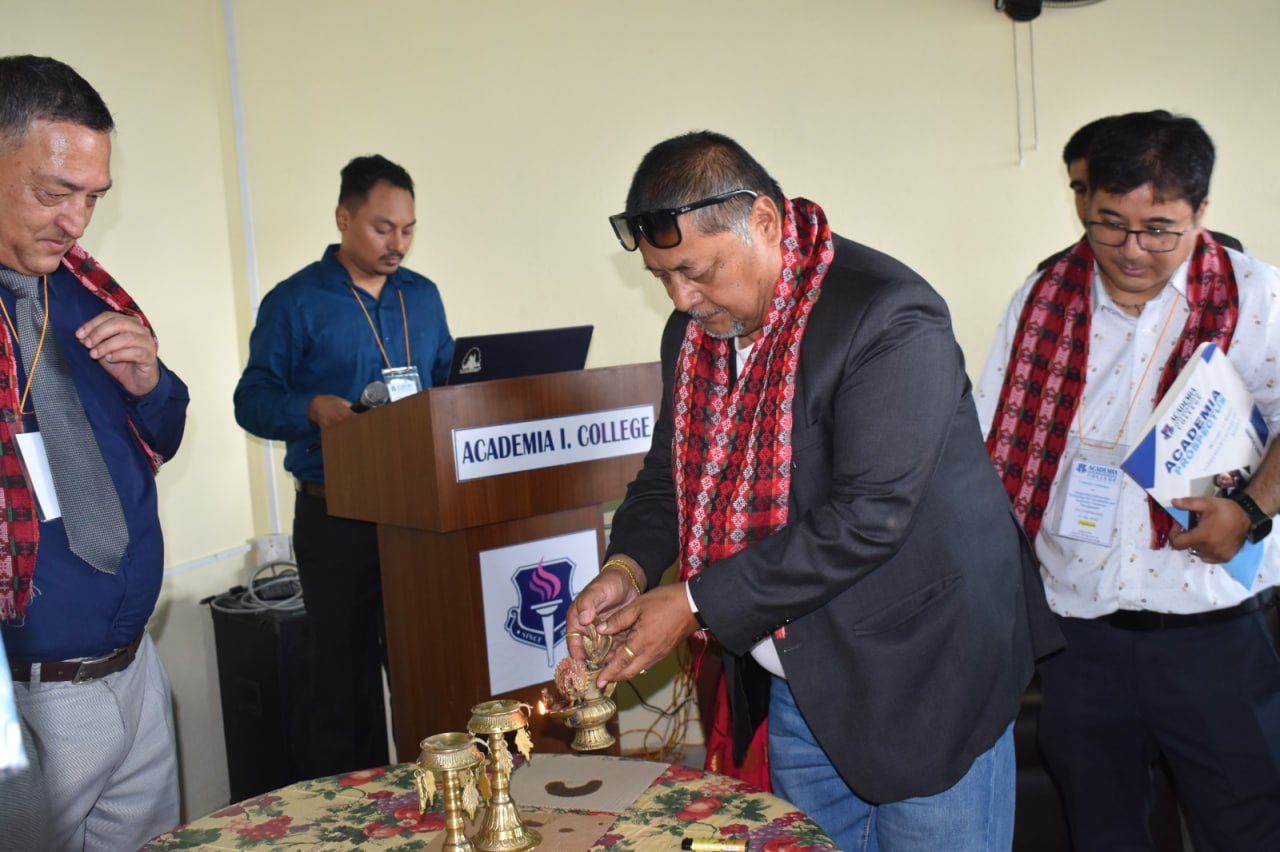
A Historic Beginning: Head of RMC Dr. Rajan Bilas Bajracharya Welcomes Delegates to Academia International College's First National Conference
Academia International College marked a significant milestone by organizing its first-ever National Conference on "Integrating Information Technology for Sustainable and Innovative Financial Management (NC-ITSIFM-2026)." The event symbolized the institution's growing commitment to promoting research, innovation, and academic excellence.
Delivering the welcome address, Dr. Rajan Bilas Bajracharya, Head of the Research Management Cell (RMC), warmly welcomed the chief guest, distinguished keynote speaker, session chairs, invited guests, researchers, faculty members, students, and participants from various institutions. He described the conference as more than an academic gathering, calling it the beginning of a new chapter in Academia International College's journey toward building a vibrant research culture.
Dr. Bajracharya highlighted that higher education must extend beyond classroom instruction by encouraging inquiry, collaboration, and knowledge creation that addresses real-world challenges. He emphasized that the conference was initiated to provide a platform where scholars, professionals, policymakers, and students could exchange ideas, present research, and develop solutions for contemporary issues.
Reflecting on the conference theme, he noted that rapid technological advancement is transforming financial management through innovations such as artificial intelligence, big data analytics, blockchain, cloud computing, fintech, cybersecurity, and digital governance. He stressed that integrating these technologies with sustainable financial practices is essential for creating transparent, efficient, resilient, and inclusive financial systems.
Dr. Bajracharya also acknowledged the importance of research in supporting industry, informing public policy, and contributing to national development. He encouraged participants to actively engage in technical sessions, exchange knowledge, build professional networks, and collaborate across disciplines.
The conference featured distinguished keynote speakers and twenty selected research papers representing diverse perspectives on information technology, finance, innovation, and sustainability. He expressed confidence that the discussions would generate valuable insights and inspire future research collaborations.
In closing, Dr. Bajracharya conveyed his sincere appreciation to the college management, organizing committee, reviewers, authors, volunteers, faculty members, administrative staff, and students whose collective efforts made the conference possible. He thanked all participants for becoming part of this historic occasion and expressed his hope that the inaugural conference would establish a lasting tradition of academic excellence and strengthen the culture of research at Academia International College.
The opening address set an inspiring tone for the conference, reaffirming Academia International College's vision of connecting research, technology, and sustainable development for the benefit of society.
Speeches by the Chief Guests
Prof. Dr. Gyan Pradhan, joining from Christopher Newport University in the United States, brought an international academic perspective to the conference's core theme of integrating information technology into sustainable and innovative financial managemen, a natural bridge given the day's emphasis on global trends in AI, big data, and FinTech. Kul Bahadur Maharjan, Chairman of Lalitpur Metropolitan City–7, spoke from the standpoint of local governance, connecting the conference's academic and technological focus to the practical realities of financial management and sustainable development at the municipal level.
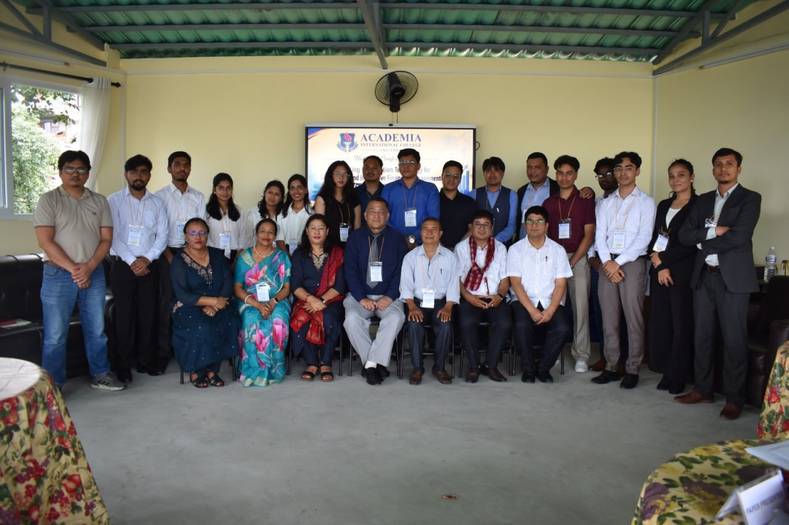
This was followed by concluding remarks from Anita Singh and a group photo session, closing out the inaugural segment.
Highlight: Why This Conference Matters
Nepal's financial sector, from cooperatives to capital markets, is being reshaped by AI, big data, and FinTech at a pace that outstrips much of the existing regulatory and academic conversation. NC-ITSIFM-2026 was conceived as a space to close that gap: pairing keynote-level thinking on digital governance with grounded, on-the-ground research on everything from investor psychology to cybersecurity awareness.
Keynote Session: Charting the Path of Digital Finance
The keynote session ran from 9:00–10:30 AM in the Seminar Hall, featuring three speakers, each addressing a distinct facet of technology's role in financial management.
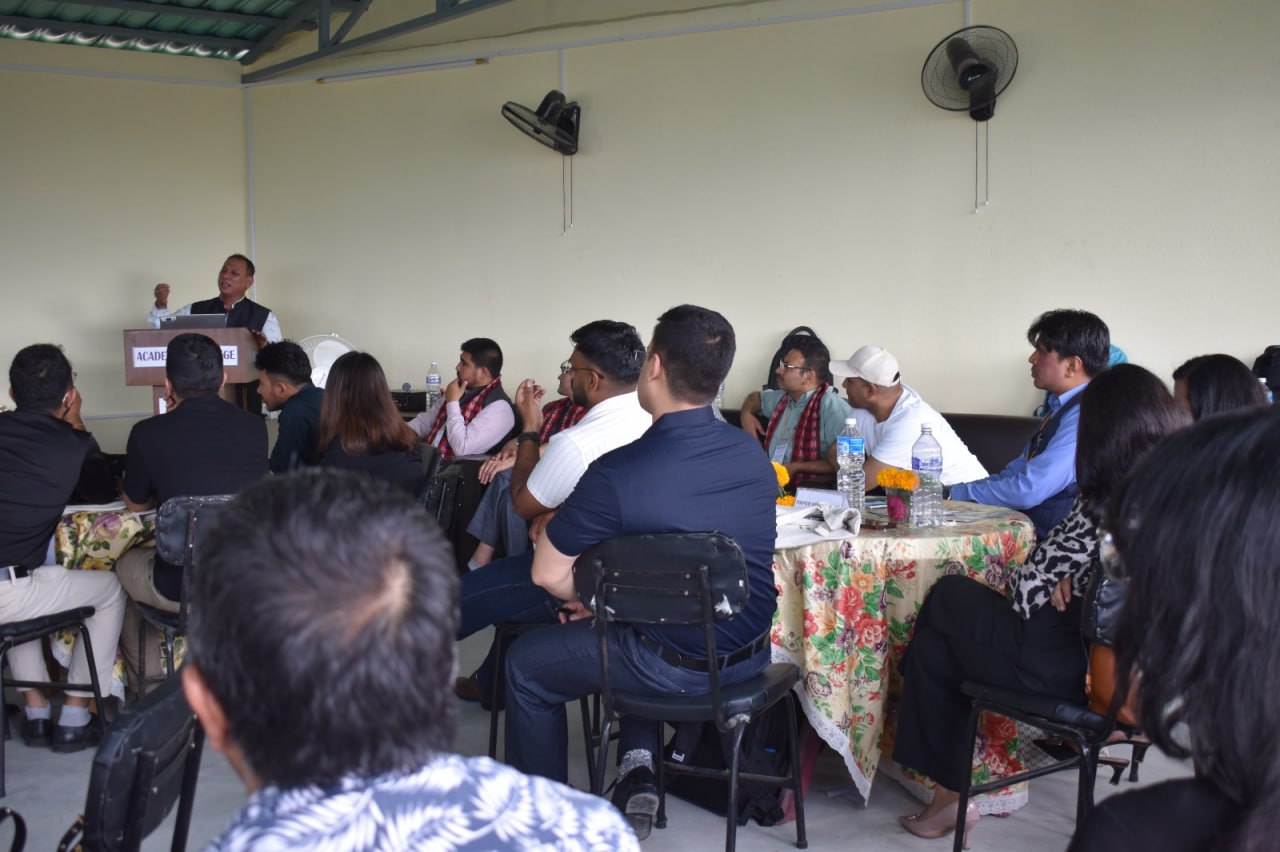
Rajesh Prasad Shrestha (9:00–9:30 AM)
Speaking on "Digital Transformation of Financial Management: Leveraging AI, Big Data, and FinTech for Organizational Excellence," the session focused on how organizations can harness artificial intelligence, big data analytics, and financial technology platforms to modernize financial operations and improve institutional performance.
Prof. Jeetendra Dangol, PhD (9:30–10:00 AM)
Addressing "Technology-Driven Sustainable Finance: Building Resilient and Inclusive Financial Ecosystems," this keynote centered on how digital tools can be directed toward building financial systems that are not only efficient but also resilient to shocks and inclusive of underserved populations.
Prof. Subarna Shakya, PhD (10:00–10:30 AM)
Closing the keynote session, this address on "Digital Governance and Smart Financial Ecosystems: Integrating Information Technology for Sustainable and Innovative Financial Management" tied directly back to the conference's core theme, framing digital governance as the connective layer between technology adoption and sustainable financial outcomes.
Together, the three keynotes moved from the organizational level (Shrestha), to the systems level (Dangol), to the governance level (Shakya), giving the day a coherent intellectual arc before the research presentations began.
Technical Sessions: Research in the Room
Following a short break, the conference split into parallel technical sessions where scholars and researchers presented original work.
Technical Session I — Seminar Hall A (10:30 AM–12:00 PM)
Chaired by Prof. Jeetendra Dangol, PhD; Co-Chair Boddy Pradhan
Seven papers were presented, spanning:
- Ethical AI use among BBA/BBM students (Shreejan Shakya)
- Trust and distrust dynamics in e-commerce (Subhadra Kaphle)
- Green HR practices and sustainability in hospitality (Nabin Kanaujiya)
- Digital financial literacy among senior citizens in Kirtipur (Lakshana Ranjit)
- LinkedIn personal branding and undergraduate employability (Junu Hada & Santosh Dhungana)
- ESG and stakeholder-centric organizational resilience (Pramod Raj Upadhyay, PhD)
- Female traders' experience of stock market volatility (Prakash Kaji Tamarkar)
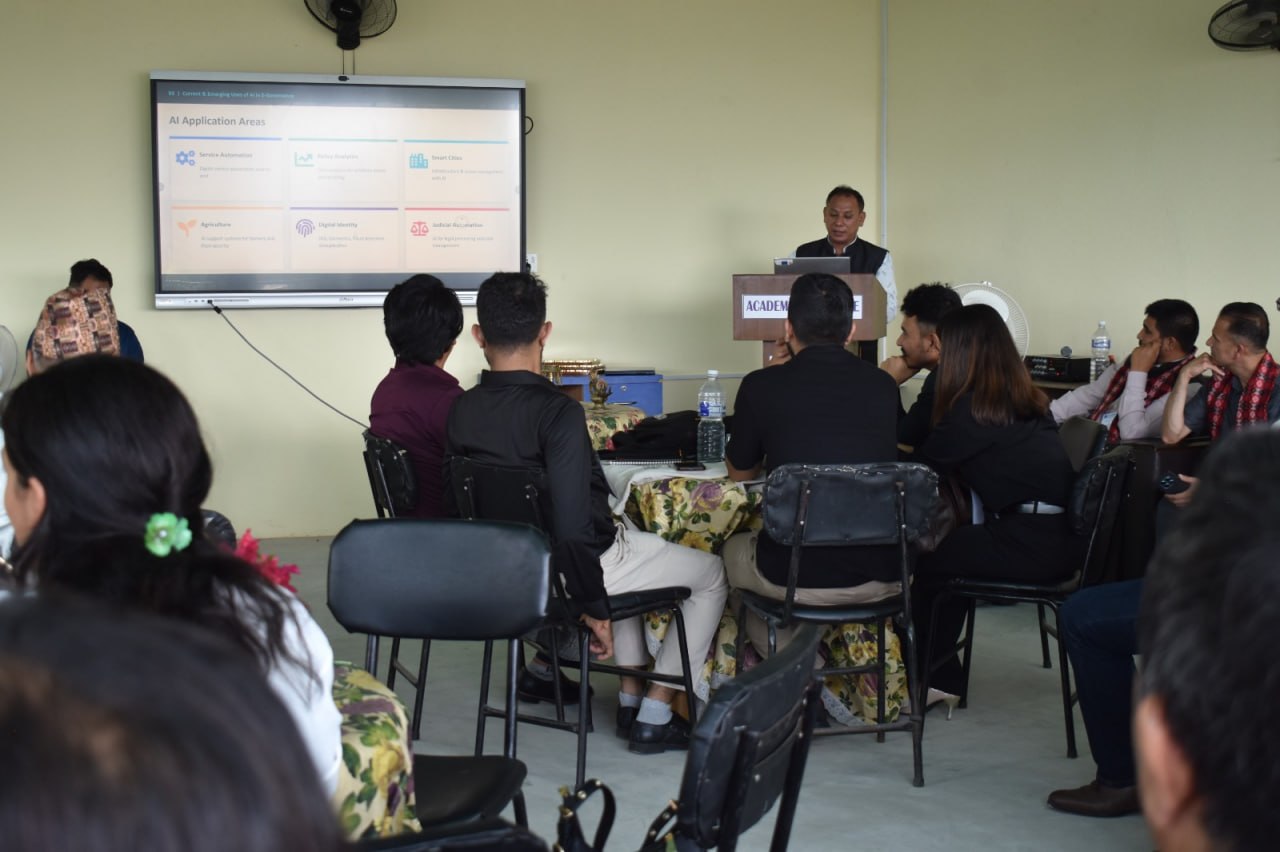
Technical Session II — Hall B (10:30 AM–12:00 PM)
Chaired by Dasarath Neupane, PhD, PDF; Co-Chair Dipak Mahat, PhD, PDF, D.Litt. Scholar
This session covered:
- Emotional intelligence and work-life balance in Nepal's IT sector (Raj Kumar Shrestha)
- Financial sustainability of savings and credit cooperatives (Swostika Adhikari)
- A phenomenological look at EAP education in Nepal (Prajwol Thapa)
- Investment behavior and loss aversion among youth investors (Pratigya Pokharel & Puskar Ayer)
- Herding behavior in stock market investment decisions (Basant Katuwal, Bibek Poudyal, Keshaba Chokal, Keshaba Rokaya, Gautam Bohora)
- Digital well-being and academic performance through a self-determination lens (Kriti Nepal)
- Cybersecurity awareness among online learners at Nepal Open University (Rashesh Vaidya, PhD & Ubash Yadav)
Highlight: The Research in Numbers
Across Technical Sessions I and II alone, 13 research papers were presented by scholars ranging from PhD-holders to M.Phil. and PhD scholars. covering ground as varied as AI ethics in classrooms, cooperative finance, cybersecurity, and investor psychology. It's a snapshot of how “technology and financial management” as a theme naturally pulls in HR, education, behavioral finance, and digital governance under one roof.
Technical Session III — Hall A (1:00 PM–2:30 PM)
Chaired by Prof. Mahesh Maharjan, PhD; Co-Chair Shreejan Shakya, PhD Scholar
Seven papers were presented in this post-lunch session, spanning:
- Automated nutrient dosing and monitoring system for hydroponic crop production (Aradhya Dhungel, Dikshya Khatri, Nischal Dangol, Pankaj Kumar Mehta, Anup Shrestha)
- A non-greedy, spatially-indexed route-finding algorithm for public transit in Kathmandu Valley (Sohan Mehta, Sandip Pandey, Santosh Kumar Yadav, Shrisha Bhatta, Er. Anup Shrestha)
- Intrusion detection in Secure Shell (SSH) using Multilayer Perceptron, Linear SVM, Decision Tree, and Naïve Bayes classification (Amit Chapagain)
- Mediating role of management commitment in the relationship between green finance and competitive advantage (Bhawana Kafle)
- Digital service quality: Gen Z vs. Millennials (Sajita Paudel)
- AI-driven cybercrime and whether Nepal's legal framework is ready (Riti Shrestha)
- AI in Economics (Rojina Awale)
Where Sessions I and II leaned toward organizational behavior, education, and financial inclusion, Session III had a noticeably more technical and computational character, machine learning-based intrusion detection, algorithmic transit routing, and IoT-style hydroponic automation sat alongside green finance and cybercrime-law research, rounding out the day with a strong applied-technology flavor.
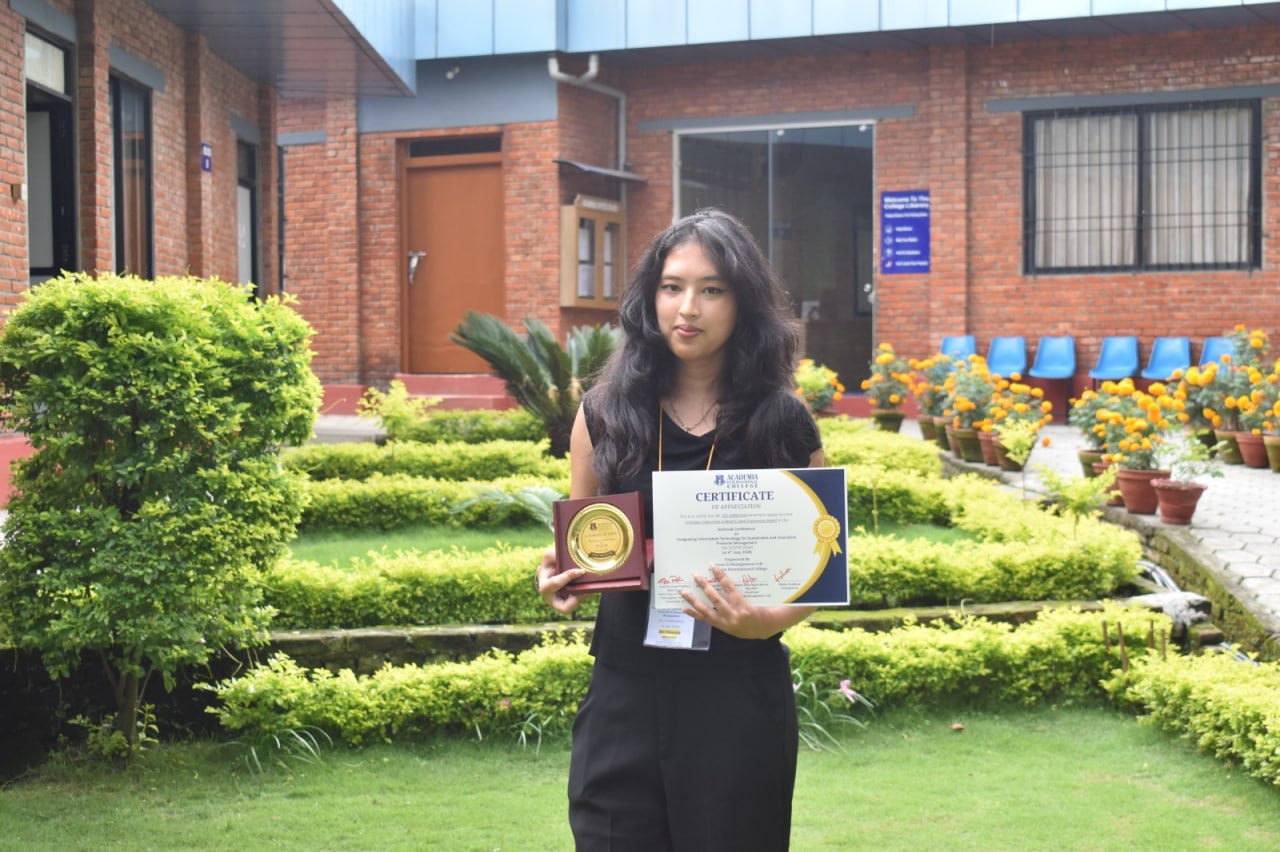
Each technical session concluded with certificate distribution and a token of appreciation for presenters, followed by group photos.
Valedictory Session: Closing the Day
The conference concluded with the Valedictory Session from 2:30–3:30 PM (bridged with the scheduled tea break and certificate distribution), again emceed by Bishwas Mathema. The dais featured the Chairman, Campus Chief and Head of RMC.
Two participants shared their overall impressions of the day's program, tokens of appreciation were presented to the keynote speakers and session chairs/co-chairs, and Sunita Shrestha delivered the vote of thanks, formally closing NC-ITSIFM-2026 with a final round of photographs.
Final Reflection
NC-ITSIFM-2026 captured something worth noting about where financial management research is heading: it's no longer a conversation confined to accounting ledgers and monetary policy. It now sits at the intersection of AI ethics, cybersecurity, behavioral economics, sustainability, and digital inclusion, and a single day at Academia International College managed to touch nearly all of it.
This post is based on the official program schedule for NC-ITSIFM-2026. Speaker affiliations, session themes, and paper titles are drawn directly from the conference schedule; direct quotations from speakers were not available in the source document and have not been fabricated.