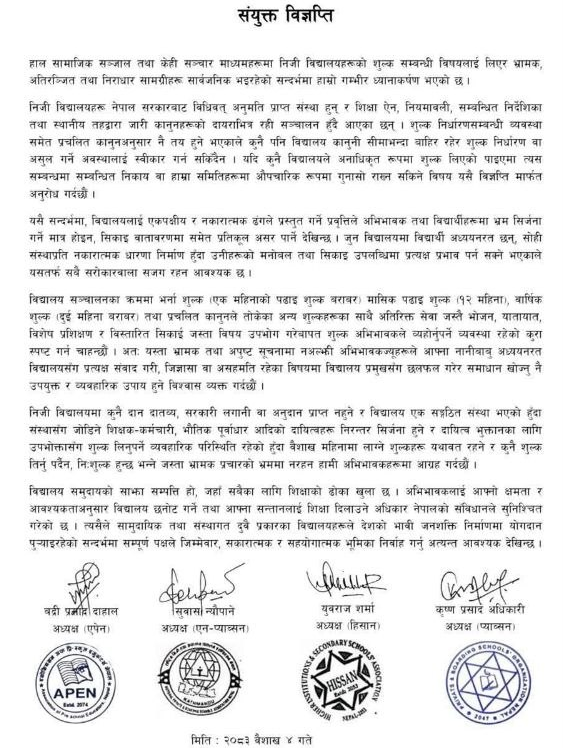





Private school organizations, including APEN, NPABSAN, HISSAN, and PABSON, have issued a joint press statement addressing what they describe as misleading and exaggerated information circulating on social media and some media outlets regarding school fees.
The organizations stated that private schools in Nepal operate with official approval from the Government of Nepal and are governed by the Education Act, related regulations, directives, and laws issued by local governments. They emphasized that fee structures are determined in accordance with prevailing laws, and any unauthorized fee collection is not acceptable. They have urged stakeholders to lodge formal complaints with concerned authorities or respective committees if such cases arise.
Expressing concern over one-sided and negative portrayals of schools, the statement noted that such narratives can create confusion among parents and students while also affecting the overall learning environment. It highlighted that negative perceptions toward a school may impact students’ morale and academic performance.
Clarifying the fee structure, the organizations explained that schools may charge an admission fee equivalent to one month’s tuition, a monthly tuition fee for 12 months, and an annual fee equivalent to two months’ tuition, along with other charges as permitted by law. Additional fees may apply for optional services such as meals, transportation, special training, and extended learning facilities.
The statement further noted that private schools do not receive donations, government funding, or subsidies. As institutional entities, they bear continuous financial responsibilities related to staff, infrastructure, and operations, making fee collection necessary. It also addressed misinformation suggesting that fees for the month of Baisakh would be waived, urging parents not to be misled by such claims.
The organizations have encouraged parents to directly communicate with their respective schools to address any concerns or disagreements. They emphasized that constructive dialogue remains the most effective way to resolve issues.
Concluding the statement, the organizations reiterated that schools are a shared asset of the community and that both community and institutional schools play a vital role in developing the country’s future workforce. They called on all stakeholders to act responsibly and contribute positively to the education sector.