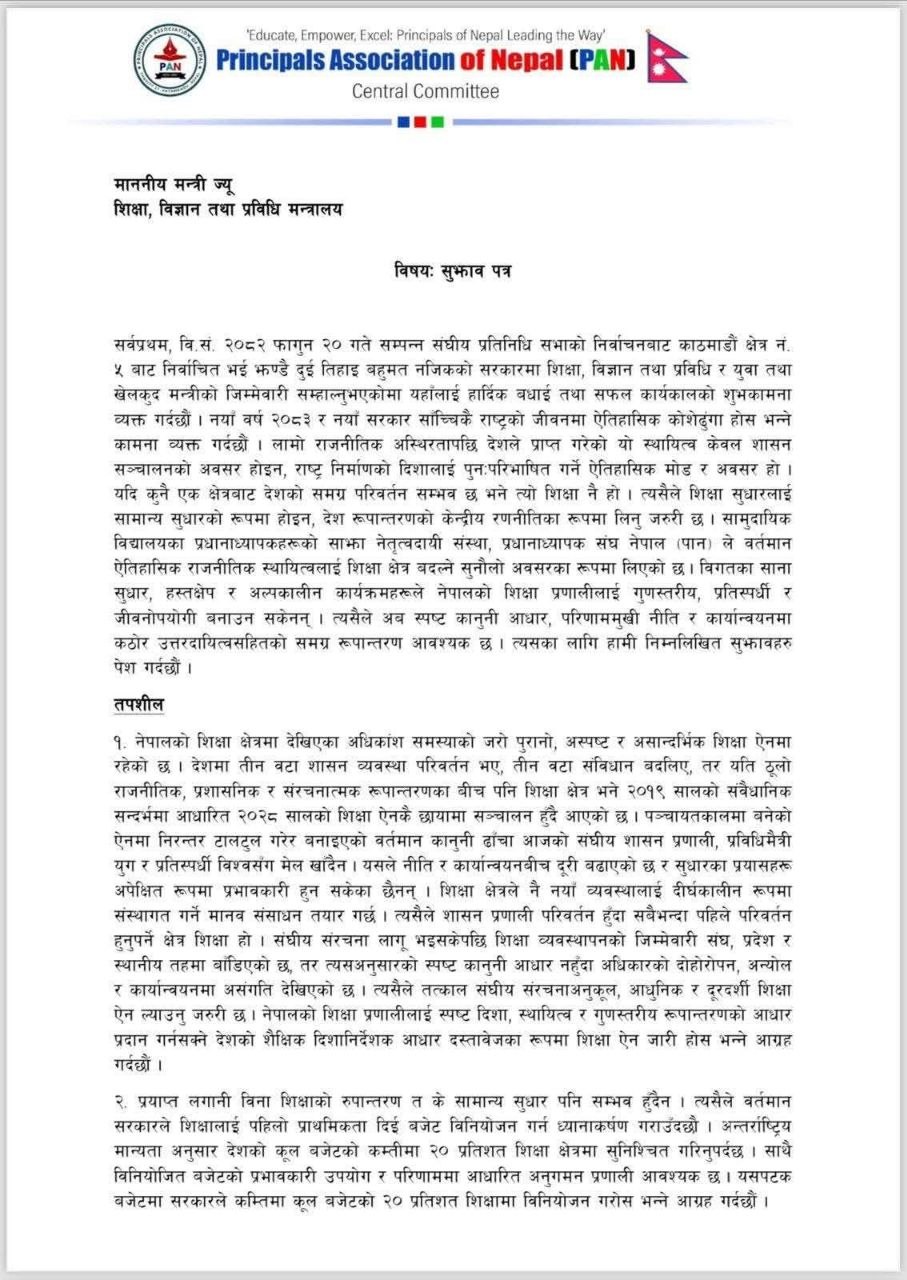






The Principals Association of Nepal (PAN), Central Committee, has submitted a set of policy suggestions to the Minister for Education, Science and Technology, calling for comprehensive reforms in Nepal’s education system.
In its formal letter, PAN extended congratulations to the minister on his election and appointment, expressing optimism that the current political stability provides a historic opportunity to transform the education sector. The association emphasized that education should be treated as the central strategy for national transformation rather than a routine area of reform.
PAN stated that Nepal’s education system is still largely governed by the Education Act of 1971 (2028 B.S.), which has undergone only incremental revisions over decades. It argued that the existing legal framework is outdated and incompatible with the federal structure, technological advancement, and global competitiveness. The association urged the government to introduce a new, modern, and federal-aligned education act as a foundational policy document for long-term reform.
The organization also highlighted the need for increased investment in education, recommending that at least 20 percent of the national budget be allocated to the sector. It stressed the importance of efficient use of funds and result-based monitoring systems.
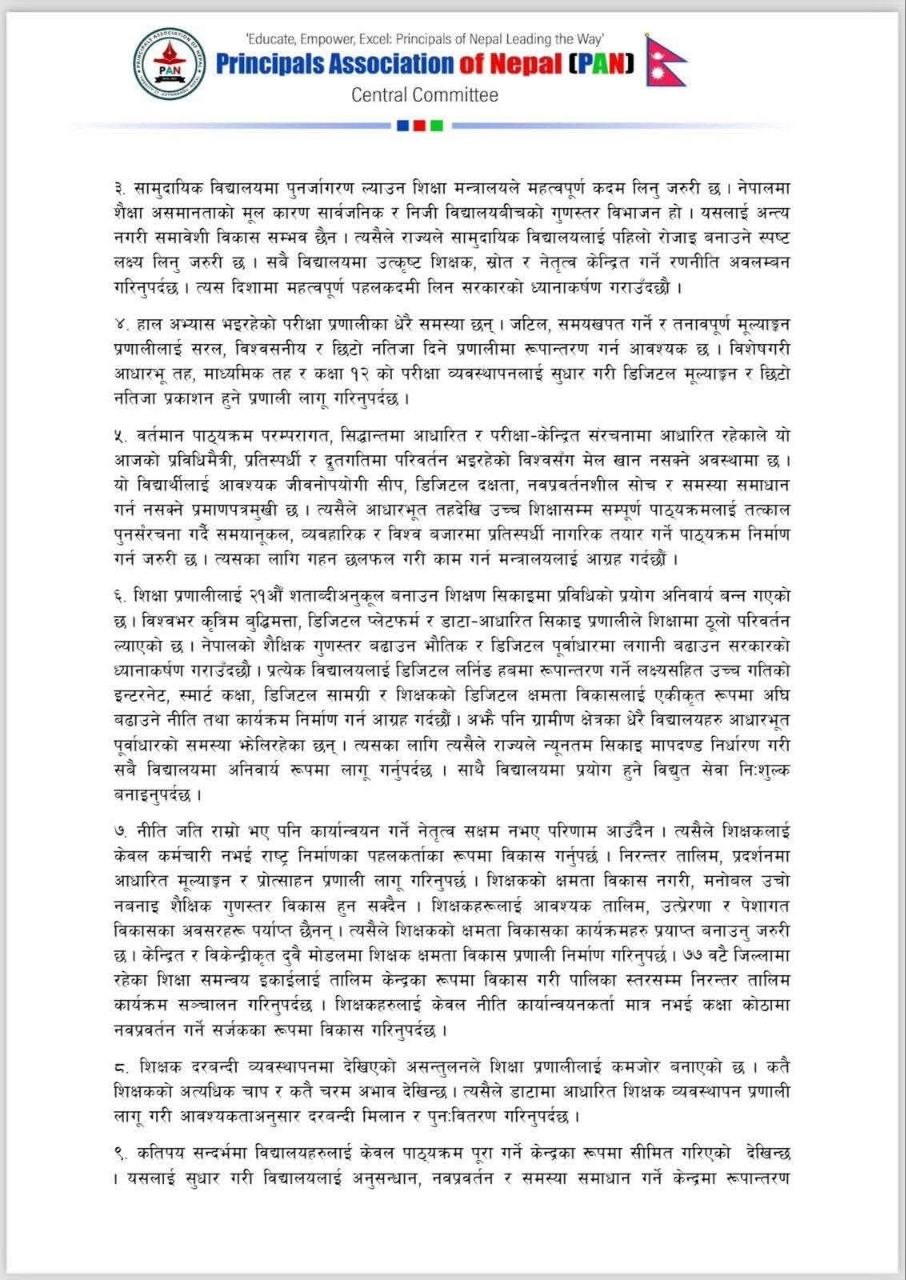
Among its key suggestions, PAN called for revitalization of community schools to reduce the quality gap between public and private institutions, making public education the preferred choice through improved teacher allocation, resources, and leadership strategies.
The association also recommended reforming the examination system to make it simpler, faster, and more reliable, including digital assessment methods and timely result publication, particularly for basic, secondary, and Grade 12 examinations.
On curriculum reform, PAN stated that the current structure remains traditional and exam-oriented and is not aligned with modern, skill-based, and technology-driven global demands. It called for a comprehensive restructuring from basic to higher education to develop practical skills, digital literacy, innovation, and problem-solving abilities.
The letter further emphasized the integration of technology in education, including digital learning platforms, smart classrooms, high-speed internet access, and teacher digital capacity development. It also proposed establishing minimum learning standards for all schools and ensuring free electricity for educational institutions.
Highlighting the importance of teachers, PAN recommended continuous training, performance-based evaluation, and professional development systems. It also proposed using education coordination units across all 77 districts as training hubs to strengthen teacher capacity.
The association raised concerns over teacher distribution imbalance and suggested implementing a data-driven system for equitable allocation and redeployment of teaching staff.
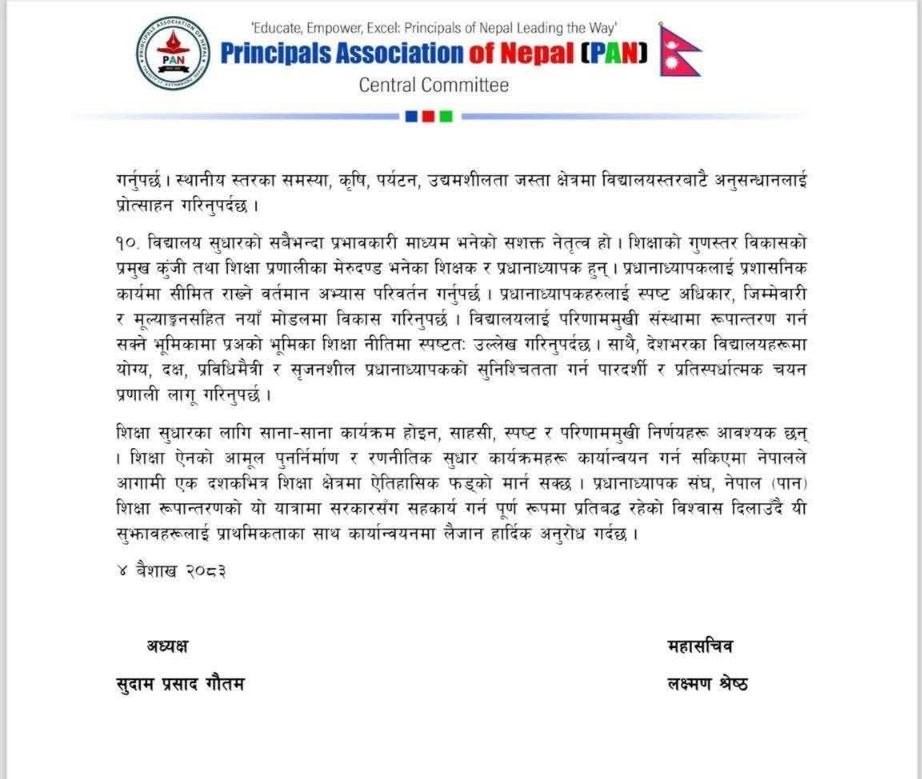
It also urged schools to be transformed into centers of research, innovation, and problem-solving, encouraging student engagement in local development areas such as agriculture, tourism, and entrepreneurship.
Finally, PAN emphasized strengthening school leadership by empowering principals with clear authority, responsibility, and performance-based evaluation. It called for a transparent and competitive selection process for appointing qualified and innovative school leaders.
Concluding the letter, PAN stated that meaningful transformation in education requires bold and result-oriented reforms rather than small-scale interventions. It expressed readiness to collaborate with the government in implementing these reforms to achieve a significant breakthrough in Nepal’s education system within the next decade.