






Every year, as the new academic session approaches, many parents in Nepal face a familiar stress: schools demanding admission fees even when their child is simply moving to the next grade. For many families, the start of the academic year has become synonymous with a heavy financial burden.
Among various school charges, the “admission fee” in Nepal is one of the most confusing and controversial. But in 2026, the government has sent a clear message: admission is a one-time process, not an annual charge.
The Government of Nepal has stepped up with clearer directives, stronger enforcement, and a firm reminder that education should ease burdens on families, not add to them. Here's everything you need to know about the rules on admission fees.
Why Do Schools Ask for Admission Fees Every Year?
For years, many private schools in Nepal have treated admission fees as an annual or semi-annual charge. Parents often hear justifications like "it's for administrative processing," "seat confirmation," or "new session setup." When a child is promoted from Grade 1 to Grade 2, or even higher, the school still sends a bill labelled as "admission" or "re-admission" fee.
This practice has created widespread confusion. In reality, many schools have blurred the line between a legitimate one-time admission fee and recurring charges under different names.
Admission Fee Rules in Nepal: What the Law Says
On April 5, 2026, the Ministry of Education, Science and Technology issued a strong directive in response to address the increasing complaints from parents that some schools were enrolling students before the academic session, collecting advance fees, and charging exorbitant fees beyond approved categories, and to refrain from enrolling students before the start of the academic session. The directive references both the Education Regulations 2059 and rulings by the Supreme Court of Nepal.
Key Legal Provisions for Admission Fee:
- A student already enrolled does not need re-admission when moving to the next grade
- Schools cannot admit students before the academic session begins
Important Legal Clauses:
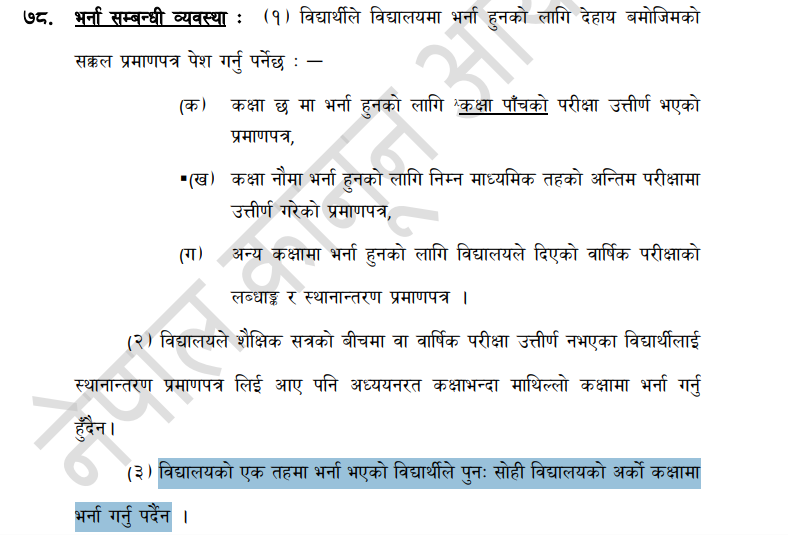
- Education Regulations, 2059, Chapter 15, Section 78 (3): A student who has already been admitted to a school does not need to be re-admitted when moving to another grade within the same school.
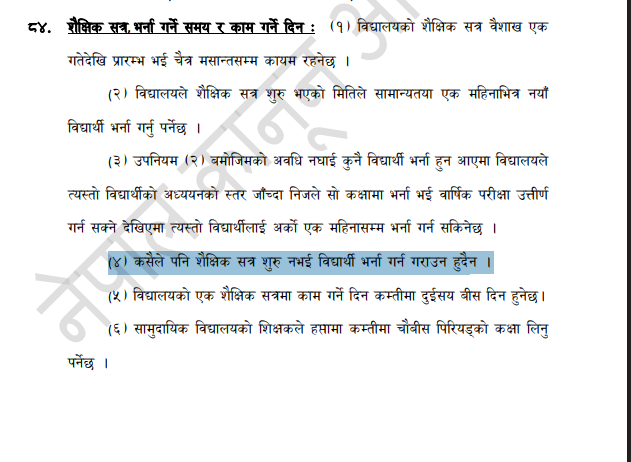
- Education Regulations, 2059, Chapter 15, Section 84 (4): No one is allowed to enroll or admit students before the start of the new academic session.
The Supreme Court of Nepal has reinforced this through rulings that prohibit schools from treating grade promotion as a new "admission." The court has emphasized that once a student is enrolled in a school, moving to the next grade within the same institution does not constitute a fresh admission.
New Admissions vs. Grade Promotion: When Is It Legal to Pay?
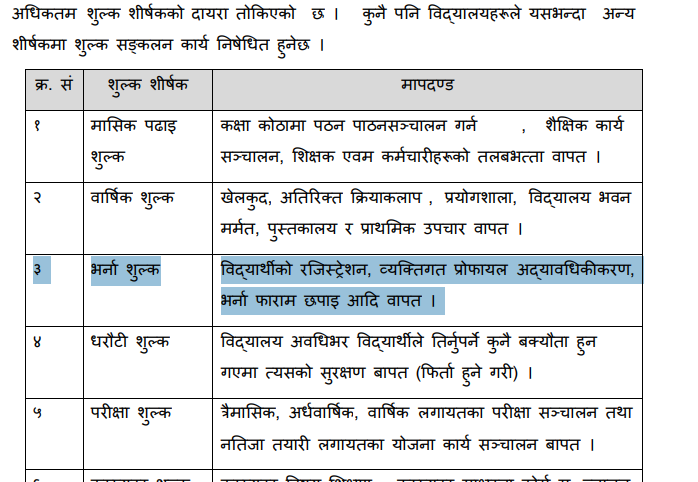
- New Admission (First Entry to the School): It is legal for schools to charge a one-time admission fee when a student joins the school for the very first time. According to the Institutional School Fee Determination and Standards Directive, 2072, the admission fee covers initial administrative costs like student registration, orientation, updating personal profiles, printing admission forms, etc.
- Grade Promotion (Existing Students): No admission or re-admission fee should be charged when a student is simply promoted to the next grade in the same school. This is the core of the "One-Time Rule."
| Category | Is Admission Fee Legal | Details |
| New Entry | Yes | Only when a student joins the school for the very first time |
| Grade Promotion | No | Moving from one grade to next in the same school is a grade promotion, not a new admission |
| Change of School | Yes | Since you are entering a new institution, they can charge an admission fee |
Security Deposit vs. Admission Fee:
- Security Deposit: This is a refundable amount paid as a guarantee against any potential outstanding dues a student may have during their tenure at the school.
- An Admission Fee: This is a non-refundable service charge for the enrollment process. It is charged only once and must not exceed one month’s approved tuition fee.
The 2026 Crackdown: Fines and License Risks
In 2026, the government has shifted from issuing gentle reminders to taking decisive action. The Ministry of Education, Science and Technology has directed all 753 local governments across Nepal to strictly monitor school fee compliance. It explicitly orders schools to refund any admission fees collected from upgraded or existing students. Schools must stop charging re-admission fees for students continuing in the same institution. Referring to Chapter 15 of the Education Regulations 2059, the ministry reiterated that student enrollment is not allowed before the academic session begins.
Schools found violating the rules — whether by charging repeated admission fees from existing students, collecting advance or excessive fees, or introducing unauthorized fee categories — are now required to issue immediate refunds to parents. First-time violators face fines of up to Rs. 25,000, while repeat offenders risk having their operating licenses revoked. Local authorities have been fully empowered to take legal action under the Education Act. This strong crackdown aims to restore transparency in the education sector and protect parents from exploitative practices that treat schooling as a recurring business expense rather than a fundamental right.
Parents’ Action Plan: What You Can Do
Don’t stay silent if your school demands repeated admission fees. Here’s a practical step-by-step guide:
- Check the Fee Structure: Ask the school for their officially approved fee breakdown. Verify it falls within the 14 allowed categories and that no re-admission fee is charged for your continuing child.
- Request Refund in Writing: If illegal fees were collected, submit a written request for refund, referencing the April 2026 Ministry directive, Education Regulations 2059, and Supreme Court position. Keep copies of receipts and communications.
- Report Violations:
- Contact the Help Desk at the Center for Education and Human Resource Development (CEHRD), at Sanothimi, Bhaktapur, either via phone +977-1-6631075 or mail-ratthour@gmail.com or check for any updated complaint channels via the Ministry.
- Provide details: school name, receipt copies, amount charged, and proof that the student is continuing (not newly admitted).
- Engage Local Government: Report to your municipality or rural municipality’s education section, as they have monitoring authority and can impose fines.