






The “Book Free Friday” program introduced by Kathmandu Metropolitan City under the leadership of Mayor Balen Shah represents a significant shift in Nepal’s school education approach. Moving beyond textbook-heavy instruction, the initiative focuses on activity-based, skill-oriented, and student-centered learning.
With increasing discussions around scaling such models, Book Free Friday offers a practical framework for aligning classroom learning with real-life skills, creativity, and employability.
Concept and Philosophy
Book Free Friday is designed to replace traditional rote-based learning with “learning by doing.” Instead of relying on textbooks every Friday, students engage in:
- Activity-based learning
- Collaborative and group-based tasks
- Creative and experiential exercises
- Skill development and practical exposure
The program aligns with the national vision of producing students who are:
- Skill-oriented
- Entrepreneurial
- Employment and self-employment ready
- Respectful towards labor and practical work
It also reflects the spirit of Nepal’s National Curriculum Framework 2076, which emphasizes competency-based and life-skill-focused education.
Program Structure by Grade Levels
One of the strongest aspects of Book Free Friday is its structured implementation across different age groups:
Early Childhood to Grade 3: Integrated Learning
At this level, the program focuses on:
- Child-centered and play-based learning
- Thematic teaching methods
- Portfolio-based student assessment
- Development of foundational behavior and social skills
Teachers act as facilitators rather than instructors, guiding students through interactive learning experiences.
Grades 4 to 8: Creative and Participatory Learning
Students are grouped into interest-based sub-groups and participate in hands-on learning activities. Each group typically consists of around 30 students and is guided by a focal teacher and trainer.
Key learning areas include:
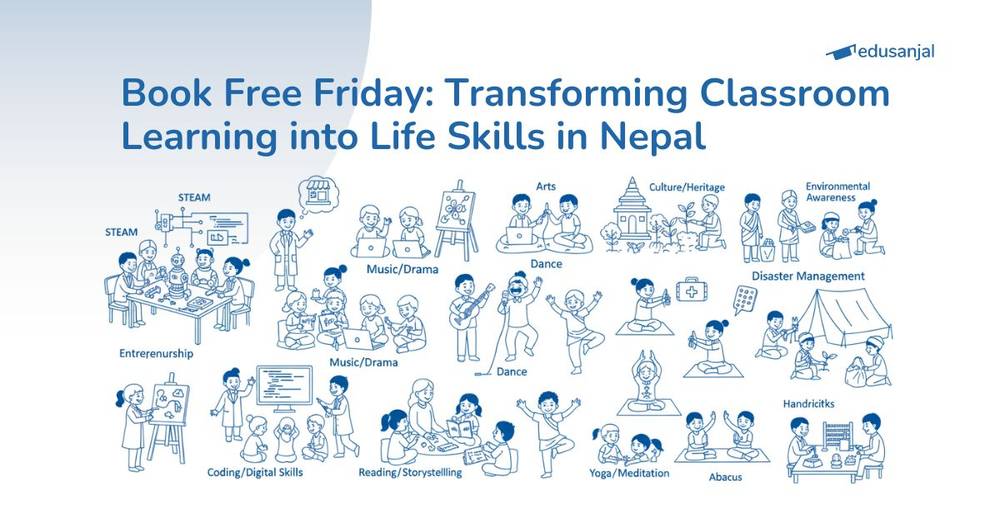
- STEAM (Science, Technology, Engineering, Arts, Mathematics)
- Entrepreneurship mindset
- Coding and digital skills
- Arts, music, dance, and drama
- Reading culture and storytelling
- Yoga and meditation
- Disaster management
- Culture and heritage
- Environmental awareness
- Handicrafts and abacus
Each subgroup follows a structured learning plan with approximately:
- 75 hours of guided learning
- 25 hours of project work
This ensures both instruction and application.
Grades 9 to 12: Skill-Based Education
At the secondary level, the program shifts toward practical and vocational skills through modular training.
Students can choose from skill areas such as:
- Agriculture and urban farming
- Culinary arts
- Fashion design
- Carpentry and wood carving
- Electrical and house wiring
- Plumbing
- Mobile and electronics repair
- Masonry (including disaster readiness)
- Beautician and hairstyling
- Sketching and sculpture
This stage directly connects education with employability, aiming to prepare students for both jobs and entrepreneurship.
How the Program is Conducted
Book Free Friday follows a well-defined structure:
Morning Session (10:00 AM – 12:00 PM)
- Project work and internal assessment
- Field visits and observation-based learning
- Practical and experimental activities
Afternoon Session (12:00 PM – 4:00 PM)
- Subgroup-based skill or creative activities (minimum 3 hours)
- Co-curricular and extracurricular engagement
- 30-minute school cleaning and beautification activity led by student groups
This structure ensures a balance between academic integration and hands-on learning.
Institutional Collaboration and Implementation
The program is not limited to schools alone. It operates through coordinated efforts among:
- Education Department of the metropolitan city
- Schools and teachers
- Resource centers and trainers
- Service providers (experts, institutions, organizations)
- Local communities
Schools can also partner with external experts and organizations for training delivery, ensuring real-world exposure for students.
Focus on Teacher Capacity and Accountability
A key pillar of the program is teacher development. Teachers are expected to evolve into:
- Facilitators
- Mentors
- Coordinators
- Learning designers
Each group is led by a focal teacher responsible for:
- Student engagement
- Program coordination
- Documentation and reporting
- Continuous improvement of activities
Regular monitoring, reporting, and evaluation mechanisms are built into the program to ensure quality implementation.
Funding and Resource Management
The program includes structured financial provisions to support implementation:
- Budget allocation per student group
- Funding for trainers and materials
- Provision for project-based learning resources
- Clear guidelines for expenditure and accountability
This ensures that schools have the necessary resources while maintaining transparency.
Why Book Free Friday Matters
The significance of Book Free Friday goes beyond a weekly activity. It addresses key gaps in Nepal’s education system:
- Over-reliance on rote learning
- Limited exposure to practical skills
- Weak linkage between education and employment
- Lack of creativity and critical thinking opportunities
By integrating skills, creativity, and real-life applications, the program promotes holistic development.
Potential for National Replication
Although currently implemented at the local level, Book Free Friday presents a scalable model for education reform across Nepal. If expanded thoughtfully, it could:
- Standardize experiential learning nationwide
- Strengthen skill-based education
- Support the development of an employable youth population
- Transform classroom environments into innovation hubs
However, scaling would require investment in teacher training, infrastructure, and local adaptation.
Book Free Friday is more than an educational experiment; it is a structured attempt to redefine how students learn. By connecting knowledge with practice, creativity with skills, and education with livelihood, the program offers a forward-looking model for Nepal’s education system.
If sustained and scaled effectively, it has the potential to reshape classrooms into spaces where students do not just study subjects, but learn how to live, work, and create.
Reference: Kathmandu Metropolitan City Book Free Friday Directives 2082.pdf