
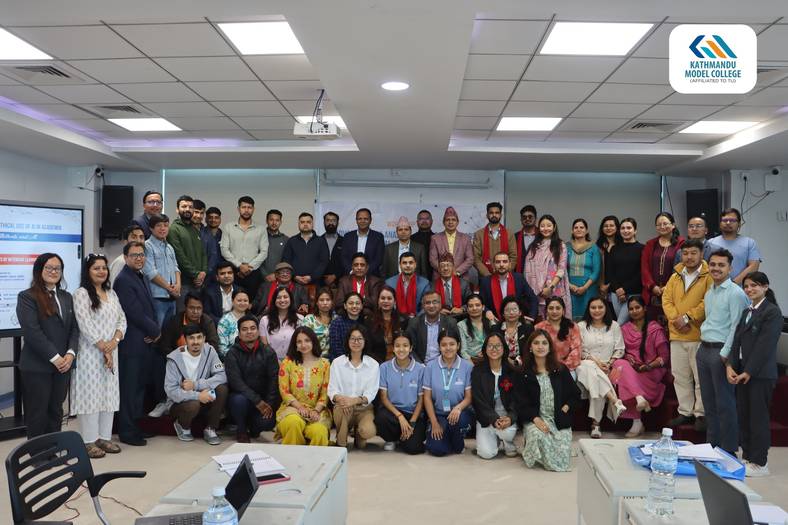

Kathmandu Model College (KMC) successfully conducted a three-day UGC-funded workshop titled “Advanced Data Analysis, Research Methods, and Ethical Use of AI in Academia” from Baisakh 24–26, 2083 (May 7–9, 2026). The program brought together academicians, faculty members, early-career researchers, and scholars from more than 15 institutions, aiming to strengthen applied research capacity, scholarly engagement, methodological competence, and academic collaboration in higher education.
_jaVKtNy.jpg)
A total of 60 participants attended the workshop. Organized by the Research Management Cell (RMC) of KMC, the workshop aligned with the college’s broader vision of strengthening research culture, critical inquiry, interdisciplinary learning, and collaborative academic engagement. It also emphasized building institutional linkages to support a more connected and responsive research ecosystem in Nepal.
The workshop followed an experiential learning model with 40% expert-led instruction and 60% hands-on practice and peer engagement, enabling participants to directly apply tools and techniques in real research contexts. Over three days, 10 resource persons facilitated 12 intensive sessions covering research design, advanced data analysis, academic writing, and ethical research practices, with emphasis on practical application and methodological clarity.
The inaugural session was chaired by Prof. Dr. Shreedhar Gautam. Prof. Dr. Mahananda Chalise attended as chief guest and Prof. Dr. Arhan Sthapit as distinguished guest.
Delivering the keynote on “Strengthening Research Culture in Academia,” Prof. Dr. Mahananda Chalise called for a shift toward a research-driven higher education system supported by collaboration, resource sharing, and institutional funding. He stated, “Academic research should not remain limited to publication. It should contribute to policy development, innovation, and societal transformation.”
Prof. Dr. Shreedhar Gautam, Head of RMC, emphasized the need for structured institutional mechanisms for sustained research development, stating, “Research should be strengthened through clear institutional policies, well-defined guidelines, and effective mechanisms that nurture a culture of inquiry from the grassroots level.”
During the three-day workshop, participants attended intensive sessions on quantitative survey design, questionnaire development, sampling strategies, data collection techniques, PLS-SEM analysis, qualitative research design, fieldwork methods, coding, and thematic analysis using ATLAS.ti, mixed-method research frameworks, manuscript development for high-impact journals, and the ethical use of AI in research and publication.
.JPG)
The sessions were facilitated by national-level scholars, including Prof. Dr. Arhan Sthapit, Asst. Prof. Dr. Bharat Singh Thapa, Prof. Dr. Gangaram Bishwakarma, Assoc. Prof. Dr. Khagendra Acharya, Dr. Sanjay Hamal, Dr. Durga Prasad Baral, Dr. Niroj Dahal, Dr. Prakash Kumar Paudel, Asst. Prof. Dr. Balram Chapagain, and Asst. Prof. Dr. Rewan Kumar Dahal.
Speaking on institutional direction, College Chief Mr. Surendra Subedi stated that KMC is actively promoting research culture through collaboration and resource sharing. “We are committed to expanding institutional partnerships, internationalization, strengthening resource sharing, capacity building, and fostering collaborative scholarly work so that research contributes to institutional development, knowledge advancement, and addressing real-world challenges,” he said.
Participants highlighted the practical value of the workshop. Bishal Shrestha noted that the hands-on and collaborative sessions helped translate theory into practice, while Oshin Gurung stated that working through real examples strengthened both confidence and methodological understanding.
In the closing session, Prof. Dr. Gopal Paudel emphasized ethical integrity in research, urging scholars to uphold originality and critical thinking while maintaining responsible use of artificial intelligence tools in academic work.
The workshop concluded with certificate distribution, participant reflections, networking, and discussions on strengthening inter-institutional collaboration and future joint research initiatives.